AI Visibility Audit: How to Measure and Improve Your Brand in AI Search
A practical guide to checking whether AI search systems can find, understand, and confidently describe your business while building on the SEO foundations underneath.
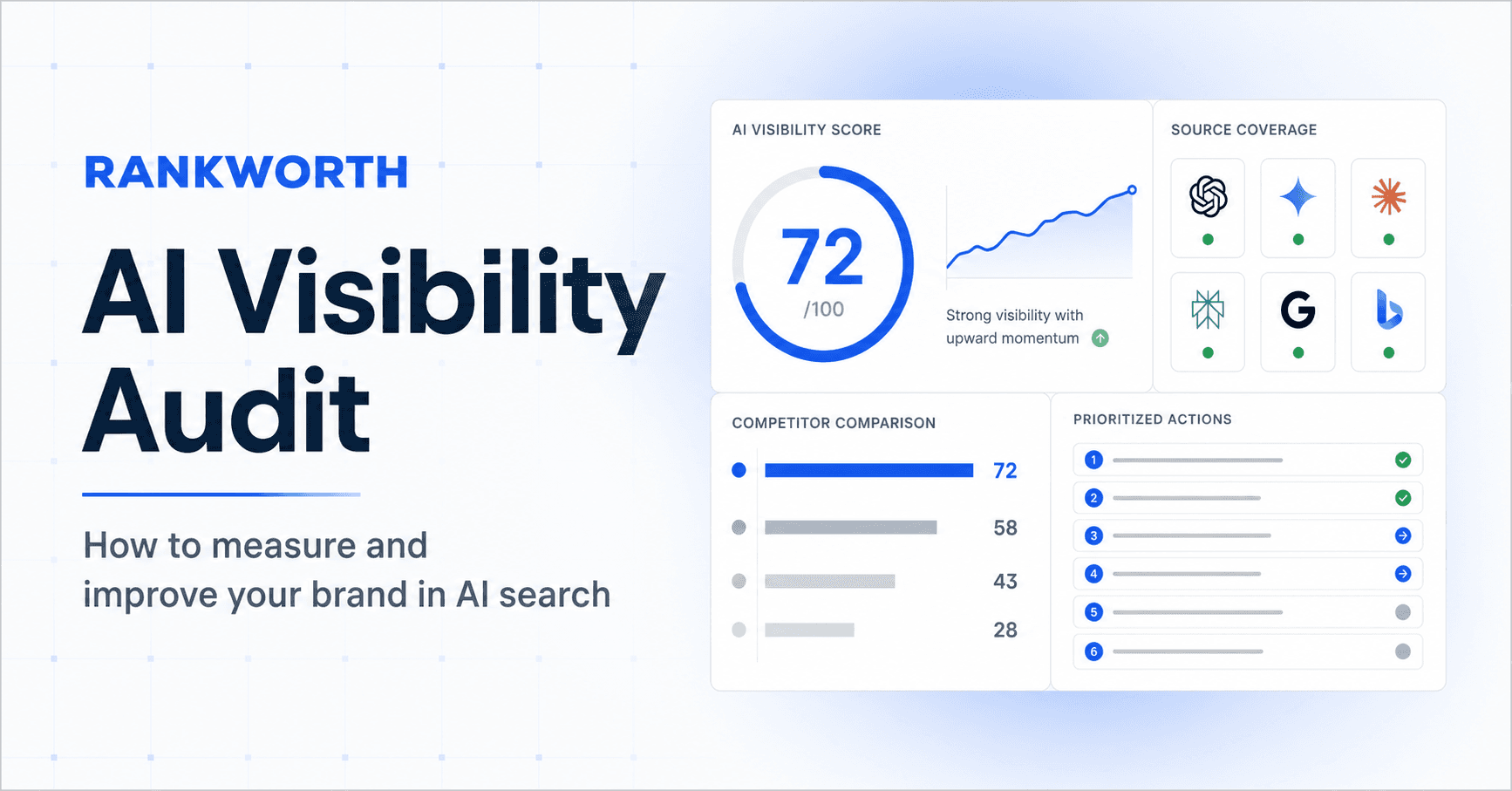
AI search visibility rarely depends on one switch. It is shaped by whether systems can reach your pages, understand what your business does, connect the right facts, and find enough useful evidence to support an answer.
That is why a useful AI visibility audit goes beyond asking whether a brand appeared in one prompt. It connects supported AI-platform evidence with the SEO foundations, content, links, structured data, and competitor signals underneath.
The short version
Start with access, crawlability, entity clarity, answer coverage, and first-party evidence. Compare the brand with visible competitors, then turn every opportunity into an action with an affected page, expected benefit, effort, confidence, and verification step.
01 / The basics
What is an AI visibility audit?
An AI visibility audit is a structured review of how clearly a business is represented in supported AI-search experiences and whether its public website provides the access, facts, and content needed to support accurate answers.
The audit should answer three practical questions: Can relevant systems reach the important pages? Can they understand the business and its offers? Is there enough distinctive, trustworthy evidence for the brand to be included when a potential customer asks a relevant question?
Reach
Can the important pages be discovered and accessed?
Understand
Are the business, services, locations, and proof clear?
Recommend
Does the site answer the questions behind the prompt?
Visibility evidence is a starting point for measurable improvement. AI answers and cited sources can change, so the audit creates an evidence-backed plan focused on what the business can control.
02 / The evidence
What should the audit measure?
A single visibility score provides a useful summary, while page-level evidence turns it into clear guidance by showing why the brand is visible, where stronger coverage can help, and how descriptions can become more accurate.
- Supported platform evidence and the prompts or topics being reviewed.
- Whether important public pages can be discovered, crawled, and interpreted.
- How consistently the business name, services, locations, people, and claims are described.
- Which customer questions have strong direct answers and which are ready for fuller coverage.
- Where competitors appear more clearly and which source or content patterns reveal the strongest opportunity.
- The exact pages and changes that should be addressed first.
Complete coverage includes every URL state
A transparent audit records every page and check it could assess, along with access gaps, crawler blocks, unreachable URLs, and incomplete coverage. That context keeps the results accurate and actionable.
03 / The overlap
AI visibility audit vs traditional SEO audit
AI visibility and SEO are different views of the same website ecosystem. Search engines and AI systems use distinct approaches, while both benefit from accessible pages, clear information architecture, useful content, consistent entities, and credible evidence.
| Question | SEO audit | AI visibility audit |
|---|---|---|
| Can systems access the page? | Crawl and index signals | Crawler access and usable source pages |
| Is the topic relevant? | Query intent and rankings | Prompt intent and answer coverage |
| Is the business understood? | On-page and structured signals | Entity clarity, facts, and supporting evidence |
| What is the outcome? | Search visibility and visits | Mentions, description quality, and cited sources |
The strongest workflow reviews them together. Rankworth's complete site analysis connects technical, content, link, schema, SEO, supported AI, and competitor evidence so the work can be prioritized once.
04 / The foundation
Check access and crawlability first
Before interpreting visibility, confirm that the pages carrying the most important facts can actually be reached. Review internal links and sitemaps, then separate crawled HTML pages from redirects, blocked URLs, canonical conflicts, noindex signals, non-HTML resources, and unreachable pages.
A page becomes a stronger source when it sits within clear site architecture, receives meaningful internal links, exposes its main content in rendered HTML, and sends consistent indexing signals. A technical SEO audit makes those dependencies visible before content work begins.
A simple access chain
Discover
Links + sitemap
Access
Robots + response
Interpret
Content + signals
05 / Clarity
Make your business easy to understand
A business should describe the same real-world entity consistently across its homepage, about page, service pages, location pages, author profiles, contact details, and structured data. Consistent names, specific service descriptions, and evidence-backed claims make that picture easier to assemble.
Start with the facts a buyer needs: what the business provides, who it serves, where it operates, who is behind it, and what evidence supports its experience. Then use structured data to reinforce the visible information so the markup and page describe the same facts.
Business identity
Name, category, ownership, people, and clear contact details.
Offer clarity
Products, services, use cases, locations, and eligibility.
First-party proof
Methods, policies, examples, credentials, and original findings.
Consistent entities
Visible content and schema that describe the same facts.
06 / Usefulness
Review content and citation signals
Useful AI-search content gives each important page a clear job, answers a real question directly, adds business-specific evidence, and makes the relationship between claims and proof easy to follow.
- Put a direct, useful answer near the start of the relevant section.
- Support broad claims with named methods, examples, data, policies, or expert ownership.
- Keep key facts in accessible page text so readers and supported systems can reach them directly.
- Connect related guides, services, comparisons, and proof with descriptive internal links.
- Update facts that have changed and show meaningful publication or review context.
Rankworth's content audit and internal link analysis show where answers can be expanded, differentiated, connected, and placed on the pages that matter most.
Connect the evidence
Connect technical checks with the full visibility picture.
See how Rankworth brings SEO, AI visibility, content, links, schema, site health, and competitors into one prioritized report.
Explore complete site analysis07 / Context
Compare competitor visibility and build your own advantage
Brand-mention evidence becomes more useful when you can see which competitors appeared, how they were described, and what supporting sources were used. That context helps distinguish broad topic opportunities from ways to strengthen the brand's own evidence.
Compare coverage as well as outcomes. Look for stronger topic clusters, clearer service pages, original resources, named expertise, and better-connected proof. A competitor analysis should guide original priorities grounded in your own expertise and evidence.
08 / The outcome
Turn every finding into a prioritized action plan
A useful audit turns hundreds of individual findings into one connected worklist. It groups related opportunities, identifies the affected pages, and explains the order of work. Critical access needs come first, followed by high-impact quick wins and the larger content or authority projects that need planning.
| Action | Evidence | Impact | Effort | Verify |
|---|---|---|---|---|
| Clarify service scope | 3 pages are ambiguous | High | Medium | Recheck answers |
| Fix blocked guide | Crawler access denied | High | Low | Re-crawl URL |
| Add first-party proof | Competitors are cited more often | Medium | High | Compare sources |
09 / The right depth
Choose the audit plan that matches the question
If the immediate priority is core technical SEO and site health for one website, Starter provides a practical foundation. If you need detailed supported AI visibility and competitor context, Pro is the natural starting point. Agency extends the same full analysis across a larger portfolio with reporting and exports.
Automated SEO and GEO
Choose how many customers you want to reach
Starter
Get hundreds of customers through Google
Automated SEO · 1 website
$97/mo
Pro
Best for AI visibilityGet thousands of customers through Google and ChatGPT
Automated SEO + GEO · 5 websites
$197/mo
Agency
Help your clients reach thousands of customers
Automated client growth · 10 websites
$397/mo
10 / Improvement
Recheck the site and measure progress over time
Implementation starts the improvement cycle. Run a fresh audit after meaningful changes, compare the coverage and findings with the previous report, and record what improved, what stayed flat, and which new opportunities emerged.
A monthly comparison creates a useful operating rhythm: complete the most important actions, recheck the evidence, and connect implementation dates with search and commercial outcomes. Individual results can have several contributing factors, and this record gives the team a much stronger basis for deciding what to do next.
AI visibility audit checklist
- Can the important pages be discovered and accessed?
- Are the business, offers, locations, and people described consistently?
- Do important pages answer a distinct customer question with useful proof?
- Do internal links connect guides, services, comparisons, and evidence?
- Is structured data valid and aligned with visible facts?
- Do competitor insights point to relevant, original work?
- Does every action include evidence, impact, effort, confidence, and a verification step?
- Is the next monthly recheck scheduled?
Grow your visibility
Get your business seen on Google & ChatGPT.
Rankworth reviews the evidence page by page, then turns it into recommendations with exact changes, expected benefits, estimated effort, and verification steps.
Questions
AI visibility audit FAQ
What is an AI visibility audit?+
An AI visibility audit reviews whether supported AI-search systems can access, understand, and accurately describe a business using its public website and other available evidence. It should connect those findings with technical SEO, content, structured data, internal links, and competitor context.
How does an AI visibility audit complement an SEO audit?+
They share crawlability, page quality, internal links, and clear business information as core foundations. An AI visibility audit adds entity clarity, answer coverage, source evidence, supported platform visibility, and how the brand is represented in generated answers.
What can an AI visibility audit help me improve?+
An audit gives you an evidence-based view of access, content, authority, and brand representation across supported platforms, so you can prioritize what the business controls. AI answers and sources can change over time.
How often should AI visibility be reviewed?+
A monthly recheck is a practical starting point for most active websites. It creates enough time to implement meaningful changes while still showing whether visibility, coverage, competitor evidence, and site health are moving in the right direction.
Which Rankworth plan includes detailed AI visibility analysis?+
Rankworth Pro and Agency include supported AI visibility, complete SEO and site analysis, competitor analysis, monthly comparisons, and prioritized actions. Starter focuses on core technical SEO and site health.